Rotating Header Image

Happy Birthday South Pole!

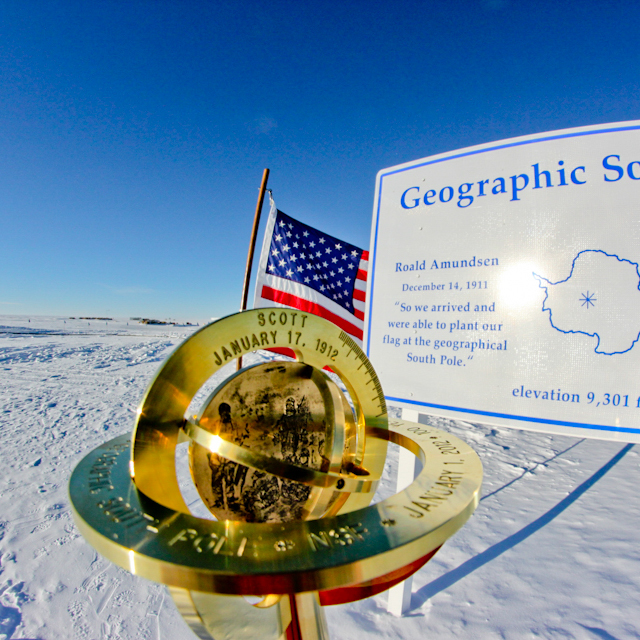
December 14th, 2011 marked the 100 year anniversary of Man first setting foot upon the Geographic South Pole of our planet.  The story behind this remarkable achievement is long and engaging, an adventure fraught with peril and courage, deceit and honor, tragedy and triumph.  The short version is that it basically all came down to a race between three men: Scott and Shackleton, both Englishmen, and Amundsen, a Norwegian.

Scott, with Shackleton serving under him, led an expedition to Antarctica in 1901.  They spent more than two years conducting scientific research and exploration, but on their furthest adventure south, fell short of the Pole by a good 350 miles.  Shackleton (slightly embittered by his subordinate position under Scott) returned at the command of his own expedition in 1909, this time coming within 100 miles of the Pole before having to turn back.

Though Scott was incredibly gracious, I can only imagine that he was clicking his heels at Shackleton’s failure, at least in his mind, and began in earnest making preparations for his next assault on the Pole.  Meanwhile, apparently unbeknownst to Scott, the famous Norwegian polar explorer Roald Amundsen, who was the first to navigate the fabledNorthwest Passage, was making his own plans to be the first to the South Pole.

Amundsen has been painted in somewhat of a treacherous light by some historians, but others only laud his praises.  I am not sure what to believe, having read a few differing accounts of Amundsen’s actions, but his devious reputation comes from the fact that during the whole of his planning phase, he made it known to everyone, including his government, his sponsors and his crew, that he was preparing an expedition to the North, but as soon as his ship left dock, he steered a southerly course and headed straight for Antarctica, with the singular goal of reaching the South Pole first.

Scott and Amundsen arrived in Antarcticaat about the same time, but not before ol’ Roald, perhaps to give Scott a fighting chance, sent his competitor a telegraph letting him know that the race was on.  Scott used ponies and prototype motorized tractors to pull his sleds, while Amundsen went with the tried and true sled dogs, which ended up paying off…  Amundsen reached the South Pole on December 14th, more than a month ahead of Scott.  He left his tent, with a curt, but congenial note inside addressed to Scott requesting him to forward it on to the King of Norway on Scott’s return should Amundsen himself not survive, and then headed back to his ship, returned to Norway, and became an international hero.  Scott, on the other hand, stoically wore the shoes of second place in true English fashion, retrieved Amundsen’s note, and trudged back the way he came.  Tragically, he and his four companions died of starvation and exposure on the return journey when they got stuck in a white-out blizzard that lasted more than a week, sardonically only 11 miles from their next supply depot.

One hundred years later, and I can only imagine what Scott and Amundsen would have thought of the bustling science base that has sprung up on the location of their perilous goal.  What was a life or death struggle for them to reach, is an easy walk for me- I don’t even have to wear a coat to get to the Pole if I move quickly.  But ultimately, none of this would be here without both of their ambition, perseverance and fortitude.  Sure, someone else would have made it eventually, but they were the first, and they are who we celebrate.  Unfortunately for Scott, he took the place of the 2nd child to be born, a day late and a dollar short, thus Amundsen and Norway get most of the glory on this day.  But Scott is still remembered, and honored, in the speeches given during the Centennial celebration, and more permanently as part of the namesake of the station.

The Prime Minister of Norway traveled to the station to celebrate the 100 year anniversary of Amundsen being the first to reach the South Pole.

The Prime Minister of Norway traveled to the station to celebrate the 100 year anniversary of Amundsen being the first to reach the South Pole.

To mark the centennial, there were quite a few special events planned here at the station.  To start, the Prime Minister of Norway flew in with his entourage, he being only the second head of state to visit the South Pole ever.  The whole station took to calling him “the Prime” for simplicity sake (but not to his face of course) and Kacey and I, in our lofty positions as stewards, had the privilege of preparing his room and making his bed.  I know it’s not quite the same, but if I were Norwegian, this would have been like fluffing Obama’s pillow.  He gave a “thanks for having me” speech to the entire station staff in the galley on the night of his arrival, and the next day we all went out and took a big group photo with him in front of the Geographic South Pole, followed by a cocktail party where his staff served traditional Norwegian holiday cookies that they had baked with the help of our chefs and a mulled wine called glögg, full of raisins and almond slivers.  I’m not a huge fan of raisins, especially when they are floating like soggy dead bugs in my drink, but since the glögg was free, and a cultural experience to boot, I consented to having a few glasses.

And this is everybody we live and work with at the South Pole.

And this is everybody we live and work with at the South Pole.

The next day was the 14th, and the whole station was invited to attend a speech by the Prime out at the Pole, which was taped by a few journalists that had showed up for the ceremony and broadcast to the world.  There followed a private banquette for all the Norwegians and a few of our upper management, but also one of our fellow stewards was invited to attend as an honored guest in recognition of a giant mural she had painted as a memorial to Amundsen.

The other big shake-up to our normal routine at the station was the arrival of over 100 tourists.  Most flew in on old DC-3s, some drove in using absolutely tough looking trucks modified for the extreme cold and snow, and the rest, the most adventurous of the bunch, skied in, hauling sleds behind them with all their equipment, some as much as 200lbs.  One grizzled old man went so far as to use Amundsen era equipment- long wooden skies, a wooden sled, fur boots and coat, and even an exact replica of Amundsen’s canvas tent.  It was a bit surprising however, and more than a little surreal, to see him pull a satellite phone from his pocket and begin dialing some far away number with his old-school fur and leather mittens.

This tent belonged to the old skier in the fur outfit, and was an exact replica of Amundsen's tent

This tent belonged to the old skier in the fur outfit, and was an exact replica of Amundsen's tent

To accommodate this hoard of centennial interlopers, our heavy machine operators groomed a large camping area about a half a mile from the station, connected to the Pole by a plowed road, where the tourists and their tour companies set up a phalanx of ground tents, some latrines, and a long, modern, jamesway for communal cooking and hanging out.  Being a tourist at the South Pole is a little different than anywhere else in the world.  Basically the only thing that they are able to see here is the South Pole itself, which even if you stretch it out by taking a bunch of goofy pictures, can only occupy your time for ten or 15 minutes at most. They are allowed a brief tour of the main station, and if they are lucky given a cookie and a hot mug of tea, but other than that, they are strictly forbidden from entering any of the other science buildings, our jamesways, or even walking through the main area surrounding the station.   I like them though, and always think it is pretty great seeing them wide-eyed and camera happy as they are slowly led from one end of the station to the other, but it can get pretty annoying and become a huge hassle if you are trying to mop the main hallway, as I often am.  The reason for the cold shoulder shown to these tourists, who have paid so much and traveled so far to get here, is because USAP’s mandate at the Pole is to conduct and support scientific research, not to be in the business of hosting travelers (except for Kacey and me that is).

Considering it is the Centennial though, and that there are about ten times as many tourists as would show up during a normal year, the powers-that-be did make a concession towards commercialization of the South Pole by setting up a warm and toasty visitor center, complete with informative displays explaining the running of the station and the different science projects going on, and also a small gift shop right outside by the Pole.  This seems a little tacky to me, the gift shop part, considering what a unique place this is.  Can you imagine coming all the way here from China, as some of them do, just to buy an Antarctica t-shirt that was made in China?  But at least they are not hawking some sort of staged photo with you holding the pole and an airbrushed penguin in the background, instantly printed and set in a cheap commemorative picture frame.  It’s actually not as bad as I make it sound- I might just be bitter because, until all the tourists leave, the station staff isn’t allowed to buy any of the new Centennial merchandise.

As we pulled into the camp, we passed one of the airplanes used to ferry in some of the tourists

As we pulled into the camp, we passed one of the airplanes used to ferry in some of the tourists

Well, after the Prime Minister’s speech at the Pole, we decided to take a walk out to the tourist camp and have a look at their digs.  On the way, one of the tour company trucks was about to overtake us on the road, so Kacey stuck out her thumb, and amazingly the guy pulled to a stop and let us climb in!  I was so stoked to get a ride in one of these vehicles that had crossed the continent by land.  It was basically just a normal Ford conversion van on the inside, but had been modified with duel axels in the back, a huge lift, and six beefy tires that had some sort of permanent bead so they could be run at extremely low pressures (4 to 6 psi) without fear of the tire popping off the rim.  The necessity of such low tire pressure, as we had similarly learned driving through the desserts of South America, is to distribute the load of each tire over a greater area thus allowing them to easily drive across hundreds of miles of soft snow.  On reaching the camp, we were dually invited into their main jamesway tent and given the tour.  There wasn’t much to see, just a bunch of camp chairs situated around a few foldout tables, occupied by weary looking adventurers trying to warm up with mugs of coffee, some chatting, some playing cards, but most just looking glum.   I don’t know if it was just because they were tired after the long flight, or even longer ski in, and now all the excitement of achieving the Pole was wearing off, or possibly they were feeling despondent after spending so much money on this three day adventure and now finding themselves in a cold, crowded, gloomy tent full of similarly dejected countenances with nothing to do.  Either way it was a bit depressing, so we gave our thanks for the hospitality and adios’d as quickly as we had come in.

On our way back to the station, we decided that even though our current positions as stewards aren’t the most desirable one’s in the world, we are glad that we came down to the South Pole how we did: working a lot- yes, but at the same time being part of a vibrant and extraordinary community; not making much money, but not spending any either; and actually being able to experience life here at the Pole, rather than merely glimpsing it as part of a fleeting, and expensive, tour.


Leave a Reply

The Ice Tunnels

Most of the time living here at the Pole, things seem pretty similar to life in the real world- we brush our teeth, do our laundry, watch movies, complain about work, eat ramen, read books, etc. etc.  But every so often, actually quite often, we’ll overhear a conversation, or catch a glimpse out of the window, or turn around an unfamiliar corner and be confronted with some as-yet unknown to us THING that exemplifies the absurdity of life in Antarctica. 

One example would be when we heard two of our veteran Polie friends talking about a problem with the “ice pier” at McMurdo.  “Ice pier?” I asked, “What in the world is an ice pier?”   “Oh” he answered, “They usually construct a huge floating pier made of solid ice, 17ft thick, to allow the annual resupply ship to dock and offload its cargo of fuel, equipment and food stocks.  But this year, due to bad weather, they were only able to make it 8ft thick, which isn’t nearly enough.  The ship is already on its way, so now they are going to have to jettison the pier into the ocean, and come up with some other way to offload the cargo.”  Only in Antarctica would the whole success of the program rely on a giant floating ice-cube.  We hear of crazy things like this every day, and it’s hard to take people serious when most of the stories they tell you could come right out of a movie.

Well, this next one does come right out of a movie, specifically Star Wars II (the old number II).  Do you remember at the beginning of the movie when Luke and Han Solo are running around through the icy tunnels of their base, trying to repel the invasion?  Well, we have those.  Ice tunnels.  Over 3000ft of them, cutting out a maze right through the solid ice, fifty feet below the surface.  Ours are used more in a utility sort of way, rather than as the main corridors of the base, but they are still very impressive nonetheless.

The tunnels are carved out of the solid ice- 50 feet below the surface

The tunnels are carved out of the solid ice- 50 feet below the surface

When we first arrived on station, we had the importance of conserving water hammered into us repeatedly: 2 minute showers, one load of laundry per week, flushless urinals, and for god sakes, turn off the faucet when you brush your teeth!  We all understood the basic reasoning behind this miserly attitude towards water use (it takes a lot of expensive fuel to produce the water), and didn’t question these self imposed rationing measures.  But it did get me thinking about where our water actually comes from?  We are, after all, surrounded by 70% of the world’s fresh water (in the form of ice), a seemingly convenient source for the station, but I certainly didn’t see people outside shoveling snow into a big pot and carrying it into the kitchen, to heat it on the stove.  So where exactly are they melting all of this ice?  The answer turns out to lie at the end of those 3000 feet of ice tunnels.

Far below the surface, the station engineers have constructed a series of deep wells that supply the community with water.  Each well, or rodwell as they are called, starts off with a bore hole, maybe 12 or 14 inches in diameter, “drilled” by an extremely hot metal probe, which melts through the ice like butter.  Once the initial hole is started, a constant flow of warm water is pumped into the well, which melts more of the surrounding ice.  The flow of warm water is controlled so that it, and the ice it melts, is pumped out at a rate quick enough so that it doesn’t freeze in the well, thereby producing an output of cool water greater than the input of hot water.  Some of this water is reheated by excess heat from the station’s power plant and returned to the well to melt more ice, and the rest is provided to the station as fresh water.  Each well starts off small, but over the course of five or six years can become an enormous cavern, 100 feet in diameter and more than 500 feet deep.  The water made from the melted ice at this depth is over 10,000 years old, and is so pure that they actually have to add minerals and salts to it before providing it to the station for consumption, else it would leach these substances out of your body when you drank it, leading to severe health problems.  It isn’t practical to continue the well past 500 feet, so when this depth is reached, the next rodwell is drilled and the process starts all over again. 

In the tunnels the tempurature never rises above -60 degrees F

In the tunnels the tempurature never rises above -60 degrees F

And now for the slightly more gross aspect of the ice tunnels… after we drink all that fresh water, and use it to cook our food, our bodies natural biological processes take over, and eventually, everything comes out the other end.  Well, all the station’s sewage, not just the toilets, but including everything from the sinks and showers as well, is collected, treated, and pumped down to the ice tunnels and into one of the empty rodwells, essentially making it the world’s biggest latrine.   As the well fills up with sewage and invariably freezes, you are ultimately left with a, well there is no polite way to say this, a 500 foot long frozen piece of poop.  It is said that in about 100,000 years, the slowly moving ice-sheet under the station will reach the edge of the continent and slide off into the ocean, along with all of our frozen rodwells of sewage, thus making for some ugly, and I imagine quite stinky, icebergs.  But, in reality, the actions of the moving ice, and the extreme pressures caused by thousands of years of snow accumulation on top of the surface, will undoubtedly destroy and dissipate any remnants of our presence here in Antarctica. 


One Comment

  1. Lynnette says:

    ohhhh what a great post on the ice tunnels! You make me never want to go there again:) Can I just re-direct people to your blog:)

Leave a Reply

SPOT

The South Pole Station is one of the most remote inhabited places on Earth- 800 miles from the nearest permanent base.  For most people, the only way to access the Pole is via aircraft.  There are a very few adventurous souls who cross-country ski in, and a slightly larger number of people who mount overland expeditions using modified trucks or vans, capable of withstanding the extreme cold and harsh snowy terrain- but both of these last groups are what we here at the station call “tourists”.  I don’t wholly disagree with the designation, but I tend to think of them with a little more admiration than most of the old time Polies who have a propensity to sneer when they say the word. For me, being a tourist isn’t always such a bad thing, and I might go so far as to classify myself as one in my current situation, just with a far longer stay at the Pole compared to the few hours or days that the normal tourists are here for.  The other difference between me and them, besides length of stay, is that I didn’t drop $40,000 to $60,000 for the privilege of achieving the Pole.  Granted I have to scrub dishes for four months and they don’t, but I still think I got the better deal.

That being said, I have an ingrained proclivity towards experiencing a place by overland travel, and a huge respect for those who hold the same inclination, regardless of how much money they invest (blow) on such a trip.  The trials and tribulations of overland travel can be overwhelming, but the reward of seeing a place up close, feeling the dirt (or ice) under your feet, and letting the air of first hand experience fill your lungs, is more than worth it in my opinion, and far better than dumbly watching a miniscule and two dimensional version of the world slide by through the muted glass of a cramped flying cattle-car.  I can see the convenience and necessity of air travel, but only to an extent… I would be a happy man to travel by land or sea exclusively, for the rest of my life.

One of the monster tractors used for the SPOT

One of the monster tractors used for the SPOT

And that brings us back to the South Pole-the only other way to get here by land, besides laying down a year’s salary, is to get a job on the South Pole Traverse, or SPOT.  SPOT is basically a fuel resupply mission run from McMurdo, crossing the Ross Ice Shelf, up and over the Transantarctic Mountains via the Leverett Glacier, and across the Polar Plateau, 1132 miles to the South Pole Station.  Each SPOT mission (there are two this year) consists of about ten goliath sized tractors, each pulling a huge sled.  Some of the sleds are basically buildings with skis on the bottom- living quarters for the equipment drivers- while the rest are no more than giant sheets of thick plastic, with eight long rubber bladders on top- each bladder holding about 3000 gallons of fuel.  The motivation behind transporting fuel overland to the South Pole, rather than flying it there on LC-130s (which they also do) is the substantial savings in fuel economy of the overland versus the airlift method: for every gallon of fuel delivered via SPOT, 0.8 gallons of fuel are burned; for every gallon of fuel delivered by LC-130, 1.6 gallons of fuel are burned.

Each sled carries about 24,000 gallons of fuel

Each sled carries about 24,000 gallons of fuel

The program is relatively young, only five years of complete missions to the Pole have been accomplished (previous years of reconnaissance missions didn’t make it all the way), and they are still working out the best method to perform the operation.  To start, the road, if you can call it that, is essentially erased by shifting glaciers and blowing snow every year.  To combat this, ground penetrating radar is used to locate fissures and chasms in the ice, which are then either navigated around, or imploded with explosives.  The constantly blowing snow is another headache.  It doesn’t just cover the path, it accumulates into meter high sastrugi (a fancy word for snow drifts), which makes the Polar Plateau a frozen ocean of icy waves.  Driving over an endless rollercoaster of waist high sastrugi would not only be seat-numbing, but incredibly harsh on the vehicles and equipment.  To cope with this, each tractor is equipped with a massive snow plow on the front (to smooth the way) and the design of the plastic sleds and rubber fuel bladders is such that they kind of slither their way over the uneven terrain.

Each tractor is equiped with a plow to smooth the way

Each tractor is equiped with a plow to smooth the way

All told, it takes an average of 30 days to travel the 850 miles from McMurdo to the pole, and that’s with no rest days.  I can only imagine that this mind-numbingly slow progress would become unbearably monotonous, especially on the featureless wastes of the Polar Plateau, but the drivers I have talked to (the first mission of the season, SPOT-1, just arrived a few days ago) have all seemed in good spirits and not at all mentally unstable. In fact, 5 of the 10 drivers are returning crew from last year, which means that there must be something special about slowly driving across the endless white ofAntarctica.  For me, the idea of traveling overland to the Pole is entrancing, but just like our current positions here at the station, I think I would be perfectly content with only doing it once.


One Comment

  1. Amy Anderson says:

    Dave – haven’t your employers figured out that you are over-qualified for the job you are currently doing? Or, do you give them advice on all these projects for the fun of it?!?!

Leave a Reply